Wednesday, May 04, 2016

Hume vs. Descartes: Does Hume ever adequately respond to Descartes?


Hume gets idolized today on the Internet as sort of the paradigmatic rational human: empiricist, naturalist, atheist, a thinker who relies solely on skepticism and observation and eschews metaphysics and religion. You can find countless references to Hume's fork on blogs and forums today along with sentiments like "Hume destroyed metaphysics."

But from reading Hume I don't really see how or where Hume actually does manage to do this. Hume is an incredible philosopher and his vision and analysis and writing are pretty awesome but I can't help feel that he never really responded to rationalists like Descartes or set his own empiricist philosophy on any kind of secure foundation the way Descartes did. So let's consider the two philosophers on a critical topic: knowledge and existence.

By the end of Meditation II Descartes has basically established what he wanted to. I've never come across any philosopher who doesn't believe Descartes has definitively established a universal relation between thinking and existing and a counter to global skepticism, even if they disagree about the details of the subject of existence and of course what Descartes further inferred from this relation. But by Hume's account Descartes never should have been able to do this. Descartes explicitly tosses out both sense experience and any notion of corporeal things that comes from his imagination, yet he is able to establish a matter of fact about the world that he did not know before.

By contrast, both the positive and negative aspects of Hume's own philosophy rely on his copy principle and the relation of simple ideas to simple impressions of sense perception. Hume never gives an adequate account of what a simple impression is: a color can have hue or luminance or intensity so is it a simple impression or complex? If we reject the copy principle then the whole basis for assertions like Hume's fork falls apart. Even Hume was aware of how inadequate this principle was. If Hume's account is correct when I look at a color wheel in all the places where shades of color exist that I've never seen before there should be a blank. Since my mind has never tagged that particular shade with the name 'blue' or 'green' there is no way I could know this 'simple' sense impression is this color purely by using my imagination or reason.

Hume's empiricist theory of ideas is inadequate but this is the entire foundation on which his rejection of metaphysics and purely rational knowledge like what Descartes is doing rests. Hume doesn't even believe we can actually reason for the continued existence of something, and what beliefs we have regarding things like causality and continued existence are not from reason. Yet Descartes seems to have no problem establishing a sufficient condition for the continued existence of something, without recourse to sense experience or imagination, use only his reason.

The entire negative part of Hume's philosophy is based on his copy principle. The copy principle itself can be shown to be inadequate, but Descartes doesn't even need the copy principle to be false in his argument which precedes Hume by a century. It is almost as if Descartes is writing in response to Hume and not the other way around. Hume says our knowledge of matters of fact must be grounded purely in sense experience. Descartes says "alrighty lemme discard everything that I can possibly know through sense experience and see what I can still find."


So what really is Hume's response to Descartes' argument that yes there is knowledge we can acquire using pure rational reflection?  Hume's rebuttal can't just be Descartes isn't actually acquiring knowledge about matters of fact -- this is just question-begging.

Although Hume's influence on epistemology and reputation today are well deserved, I can't help feel the popular conception of Hume as a destroyer of metaphysics is wildly unfounded.

Friday, October 30, 2015

Harris and Free Will: Could versus Would.

P.F. Strawson's famous essay "Freedom and Resentment" influenced many philosophers.to be compatibilists.


I've been reading Sam Harris' Free Will and while I have a lot of issues with many of the things he says, I want to focus on one particular issue: his central idea that free will and moral responsibility are a simple function of whether or not we could have done otherwise at a particular point in time. In the beginning of his book Harris asserts:

Free will is an illusion. Our wills are simply not of our own making. Thoughts and intentions emerge from background causes of which we are unaware and over which we exert no conscious control. We do not have the freedom we think we have. Free will is actually more than an illusion (or less), in that it cannot be made conceptually coherent. Either our wills are determined by prior causes and we are not responsible for them, or they are the product of chance and we are not responsible for them. If a man’s choice to shoot the president is determined by a certain pattern of neural activity, which is in turn the product of prior causes—perhaps an unfortunate coincidence of bad genes, an unhappy childhood, lost sleep, and cosmic-ray bombardment—what can it possibly mean to say that his will is “free”? No one has ever described a way in which mental and physical processes could arise that would attest to the existence of such freedom. Most illusions are made of sterner stuff than this.
The popular conception of free will seems to rest on two assumptions: (1) that each of us could have behaved differently than we did in the past, and (2) that weare the conscious source of most of our thoughts and actions in the present. As we are about to see, however, both of these assumptions are false.
But this idea that free will is not 'conceptually coherent' seems to be a basic confusion between the logical form of an indicative conditional and a counterfactual conditional and I think this confusion is at the heart of Harris' and other writers' outright rejection of compatibilism. The metaphysical truth of determinism for the actual world has absolutely nothing to do with the fact that there are situations where had a person's intentions and attitudes and values and virtues been different it would have resulted in a different action. Our notion of moral responsibility for individual actions stems from whether or not such counterfactuals are true, not from whether or not our wills are determined by prior causes or if it were possible that the action could not have occurred. Harris is correct in recognizing that indeterminism is not a sufficient condition for moral responsibility, but the crucial mistake he makes is in not recognizing it is not a necessary condition either.

Suppose we have 2 sentences:

1. If Oswald did not kill Kennedy then somebody else killed Kennedy.

2. If Oswald had not killed Kennedy then somebody else would have killed Kennedy.

The first sentence is an example of an indicative conditional: A->B. It simply says if A is true then B must be true. Indicative conditionals are true by virtue of the truth values of the antecedent (A) and consequent (B) parts of the sentence. If Oswald did not fire the fatal shots at Kennedy then this fact seems to entail that somebody else must have, since it is an accepted fact of our actual world that Kennedy was killed by someone. It is not the case in the actual world that that the consequent of the first sentence can be false if the antecedent is true.

The 2nd sentence is an example of a counterfactual conditional A>B. Counterfactual conditionals are true by virtue of the existence of possible worlds where the protasis clause A is true and the apodosis clause B is true, that are closer to our actual world than possible worlds where A is true and B is false. The truth of the 2nd sentence actually depends on the entire state of our actual world at the time of the event and our reasoning about what would have been a likely turn of events had the first part of the sentence occurred. The first key thing to notice here is that while the first sentence is obviously true, then 2nd is not. And the second key thing is that how we evaluate the truth of indicative conditional sentences is completely separate to how we evaluate the truth of counterfactual conditional sentences. In the first instance we look for facts in the actual world that correspond to what is asserted by each part of the sentence. In the 2nd instance we look at the actual world as a whole and possible worlds where both parts of the counterfactual are true, that we think are nearer or more similar to our actual world than other possible worlds where the first part of the counterfactual is true but the second false.

Suppose I am trying to evaluate moral responsibility for some egregious action I took at time t. Maybe I tweeted something rude to Taylor Swift yesterday that caused her to block me. Now consider the following pair of sentences:

3. If all physical events prior to t remained the same then I could not have done otherwise.

4. If I had been a better person then I would have done otherwise.


If we accept Harris' account of the role prior causes and prior neural activity plays in our decision-making and choices, then the first sentence is true. But the second sentence is also true. The truth of the 2nd sentence does not depend in any way on the falsehood of the first. If I accept that my being a better person is simply a function of all the prior causes of our actual world i.e that I could not have been any other way than I was when I made the tweet and thus I could not have done otherwise, that does not change the truth of the counterfactual that a different set of attitudes and beliefs and intentions and values would have resulted in me being not so rude to Ms. Swift yesterday.

It's important to note that sentences like 4. are not always true. It might be the case than I was secretly subverted by a Beyonce music video that sent subliminal messages ordering me to send rude tweets to Ms. Swift. In this case 4. would not be true. And this is where the compatibilist account of free will begins. As long as we think that counterfactuals like 4. are true we believe individuals are morally responsible for their actions. If counterfactuals like these are not true, as in the case where a person's mental ability or judgement is impaired to the point that he would not be able to make a actual decision,  then we do not think individuals are responsible for their actions. The truth of counterfactuals like these is quite independent of determinism being false...indeed it is not hard to see that the truth of these counterfactuals might require determinism to be true. For how can it be the case that we know a person would have acted differently because of different intentions if we were not sure that a sequence of prior causes necessitates some action? This is where Harris and I think many contemporary writers on free will become entangled in conceptual confusion, but they do not see that there is an alternative way out.

Suppose I'm sitting in a train and a fellow passenger tries to get into the seat next to mine but ends up kicking me on my shin. My first reaction is to feel a certain resentment towards him, and his first reaction, assuming he has the same inclinations towards empathy or courtesy as the average civilized adult does, would likely be to apologize to me for his careless actions. We both feel that if he had been more careful then he would not have kicked me.

The use of would here is critical. It is not true to say if the passenger was more careful he could not have kicked me. We can imagine very easily the passenger being extremely careful and cautious getting into his seat, but due to the train hitting a particular bump he ends up kicking me anyway. Rather it is the truth of the counterfactual:

If the passenger had been more careful then he would not have kicked me.

that is the origin of both of our reactive attitudes to his action. 

I've been trying for the past day to figure out why it is that Harris in his book carries out essentially the same thought experiment P.F Strawson does in his famous essay Freedom and Resentment but arrives at essentially the opposite conclusion. Harris asks us to consider cases like the following:

4.A 25-year-old man who had been raised by wonderful parents and never abused intentionally shot and killed a young woman he had never met “just for the fun of it.”

5.A 25-year-old man who had been raised by wonderful parents and never abused intentionally shot and killed a young woman he had never met “just for the fun
of it.” An MRI of the man’s brain revealed a tumor the size of a golf ball in his medial prefrontal cortex (a region responsible for the control of emotion and
behavioral impulses).

and concludes:

Why does the brain tumor in case 5 change our view of the situation so dramatically? One reason is that its influence has been visited upon a person who (we must assume) would not otherwise behave in this way. Both the tumor and its effects seem adventitious, and this makes the perpetrator appear to be purely a victim of biology. Of course, if we couldn’t cure his condition, we would still need to lock him up to prevent him from committing further crimes, but we would not hate
him or condemn him as evil. Here is one front on which I believe our moral intuitions must change: *The more we understand the human mind in causal terms, the harder it becomes to draw a distinction between cases like 4 and 5.*

Harris thinks that the closer we come to establishing determinism as true, the resentment we feel towards the man for his actions in 4. will collapse into something like what we feel towards the man in 5. But where Harris goes wrong is that he assumes we condemn the man in 4. because we think the man must have had some kind of freedom the man in 5 did not. But the actual reason we condemn the man in case 4 is not simply because we think he could have done otherwise. This is trivially true: there's an infinite number of events that could have caused him not to shoot the young woman that have nothing to do with his intentions. Perhaps the gun could have jammed as he pulled the trigger.

The reason we condemn the young man without the brain tumor is because we know men just like him would have done otherwise because they had the right intentions or virtues or higher-order desires. That is, in a set of possible worlds close to our actual world a man just like the shooter would not shoot the woman because, for instance, he believes he has some duty to fulfill towards others. The truth of this counterfactual is the reason we hold the man in this case responsible for his actions. In the case of the man with the brain tumor this counterfactual is false. There are no possible worlds that resemble our own where the man would not have shot the woman because of different intentions, since his judgement was irreparably compromised by a physical condition. (Just as mine was because I was being mind-controlled by Beyonce).

We can see the truth of this analysis if we add the following 6th case:

6. The man in case 5 had been urged by his doctor to get a MRI as he had been experiencing mood swings and blackouts for months, but kept putting it off.

Why is it in case 6 our sense of moral responsibility switches back to holding the man responsible for his actions? It is not the case the man had any more control of his decision to shoot the girl than he did in 5. But we see that by considering the entire state of the actual world at the time of the shooting, it is certainly likely that he would have avoided shooting the girl had he listened to his doctor and been more responsible.

Harris' account of free will suffers from a lot of problems but I hope this analysis can eliminate the conceptual confusion he alleges that free will suffers from and show that compatibilism is a perfectly valid account of free will that Harris simply ignores.

Saturday, May 23, 2015

The Philosophy of (Non-)Belief: Part A

Attitudes

Imagine you have lived in a small village on a remote island in Micronesia all your life, with absolutely no contact with Western culture or media. You move to the U.S and at the airport a reporter asks you through a translator to take a poll:

1. Do you believe: 'Other minds and other subjects of experience besides yourself exist in the Universe.'
2. Do you believe: 'Santa Claus exists.'
3. Do you believe: 'California is to the west of New York.'
4. Do you believe: 'The total number of jelly-beans in the airport candy-store is even.'
5. Do you believe: 'Biological life exists on the moon.'
6. Do you believe: 'If you do good to others you will be rewarded.'

The answers to the poll questions are

A) Yes

B) No

C) I don't know

D) No because I have seen no evidence it is true.

E) Yes because I have seen no evidence it is false.

What would be the most accurate description of your mental attitude towards propositions 1-6?

1
Most likely you would say you believe 1, though you may have never considered the question consciously or thought of yourself as giving conscious assent to it. The way you behave or the way you react to your sense experience is in accordance with 1 being true. And unless you study philosophy or a related field it is highly unlikely you would ever be acquainted with the arguments and evidence that could be utilized for supporting the truth or falsity of this proposition. Only the insane and philosophers have ever posited good reasons for humans to doubt 1 (I will assume for the rest of this essay that one can unambiguously distinguish between these two classes.) In this case A would be reasonable, but perhaps E would be a more accurate response. But the hypothesis 1 is true would require considerable evidence for you to consider rejecting it, though you may not have any actual evidence to support it being true.

2-4
It could be said you lack a belief or don't believe in the truth of propositions 2-4. It could be said you don't think they are true as you have never in fact seen any evidence or reason to think they are true.

But it could also be said you do not believe that propositions 2-4 are false. And similarly, that you have never seen any reason to think they are false.

In these cases it seems reasonable that an actual lack of knowledge about the state-of-affairs described by propositions would express an attitude of neutrality, not rejection, to these propositions. It seems unusual that only a lack of knowledge regarding the truth-value of a proposition would entail one truth-value for a proposition should be privileged over another. If we imagine that there are two possible worlds where a proposition is true in one and false in the other, then it seems unlikely we would be able to say which possible world more closely resembles the one we believe we inhabit currently, unless we had some knowledge that would be relevant to this judgement.

5
In a case like this you might have considered the matter and formed an attitude and might reasonably answer B) or D). But would D) be an accurate description of your attitude to life on the moon?

Surely if you have knowledge of biology or physics then you might think such a scenario unlikely, without having to review every alleged discovery of life on the moon. You attitude towards life on the  moon is not incorrigible, surely anything is possible, but your knowledge of the necessary conditions under which this proposition would be true might lead you to privilege it being false over being true. Perhaps you think that 'There is no biological life on the moon.' should be considered the null hypothesis that must be rejected but can also fail to be rejected.

But it seems only your knowledge of the relevant conditions under which 5 would be likely or unlikely could justify you privileging one hypothesis over another. Which means a response of D) would not be accurate. Assigning the truth value 'false' to 5 need not be a conscious decision, indeed your mental representation of the world as you understand it would in fact reflect this judgement and this representation would be used whenever you read things like 'Michael Jackson found living on the moon.' to determine your attitude towards these findings. Just as the case in 1 you would in fact privilege one hypothesis over another but in this case it is the denial of a proposition that is to be rejected.
  
6
With proposition 6 you might in fact have considered this question consciously. You perhaps can recall an abundance of cases where it did not hold vs. a tiny number of cases where it did. Yet your answer to this question might still be A). Even if in your map of the world you think that it is unlikely a good deed will merit some reward, you still think that it is in some sense desirable or even necessary to assent to the proposition that it would. You might believe that our current world is much closer to a possible world where it is not true doing good will be rewarded, yet you still feel some prudential or pragmatic desire to assent to this proposition, in the face of (possibly overwhelming) evidence to the contrary.

Beliefs

If we accept this analysis of our likely attitudes towards these propositions then it would seem to illustrate some interesting properties of beliefs (and non-beliefs.)

For in the case of 1 we believe things without consciously assenting to them. It is not necessary for anyone to introduce or ask us to consider something in order for us to believe it. And it seems when such a question is asked or a skeptical challenge made, it is also rational to believe a proposition though we may not have any propositional evidence for it. And even though some powerful skeptical arguments exist that we may not have the capacity to rebut, we would still think it rational and necessary to believe a proposition like 1, as the alternative seems unacceptable to us. Skepticism or a lack of propositional evidence on its own is not sufficient for us to reject believing in a proposition, though we may not actually have propositional evidence to privilege supporting it. Some beliefs appear to play a foundational role in a superstructure of mental representation of the world.

In the case of 2-4 it seems we should be neutral about the truth and falsity of propositions if we truly lack knowledge to evaluate or make judgements about them. To assign a truth-value of T or F to a proposition or to privilege a positive or negative hypothesis over its negation based solely on our lack of knowledge about the state-of-affairs described by the proposition does not seem possible.

In the case of 5 it seems we can be non-neutral about the truth or falsity of a proposition though we do not in fact claim that a judgement of 'false' is incorrigible. But this non-neutrality is not due to a lack of relevant knowledge, rather it is the presence of relevant knowledge that justifies our non-neutrality and diverging from the neutrality of cases 2-4. Our skepticism of the existence of biological life on the moon occurs in the context of propositions we are not skeptical about

It is also true that our relevant knowledge actually affects our attitudes towards propositions that we may consider as evidence for 5. This is another feature of (non)beliefs: we cannot be neutral in evaluating evidence for a proposition that contradicts our present attitude towards a proposition.

In the case of 6 considerable evidence may exist against a proposition being true, our own evidence could be seen as selective or biased towards our presumption, yet it would still be rational to make a positive judgement or assent to a proposition. We can simultaneously believe ~A while consciously assenting to A. There is nothing irrational about this. A scientist will accept a theory and use it in their own work while still privately believing such a theory to be false.  

Does it matter?

There's a lot of discussion these days about definitions and what labels like agnostic or atheist mean or what attitudes like 'lack-of-belief' entail and how concepts like 'burden-of-proof' should be used.  A lot of people might think, justifiably, that these discussions are pointless or distractions from the issue of theists defending their beliefs. But I don't think this criticism is sound.

There is nothing wrong or pointless in analyzing the epistemology of others or how others define words or the reasoning they use to arrive at their conclusion. Consider Carl Sagan's Baloney Detection Kit.
In addition to teaching us what to do when evaluating a claim to knowledge, any good baloney detection kit must also teach us what not to do. It helps us recognize the most common and perilous fallacies of logic and rhetoric. Many good examples can be found in religion and politics, because their practitioners are so often obliged to justify two contradictory propositions.
Atheists criticize the epistemology of theists all the time and how they incorrectly use words like faith when debating ('You have faith in science.' or 'You have faith the sun will rise tomorrow.' or 'You need faith to be an atheist.') They criticize how we incorrectly use skepticism such as 'Were you there?' as a rejoinder to scientific theories about the history of the physical Earth or the origin of life. Atheists have always asserted that the epistemology of theism is flawed in innumerable ways and the arguments and strategies theists use in debate to be severely detrimental towards rational discourse. Most atheists would agree 'You can't prove God doesn't exist.' is not a rational employment of a skeptical attitude. Bertrand Russell famously argued that 'You can't prove I'm wrong.' is not a rational employment of the concept of burden-of-proof to make an argument against naturalism.

So if atheists think that contradictory propositions, illogical definitions, fallacious reasoning and incorrect use of skepticism is harmful to a discussion, then atheists of all people should be willing to have their use of words like 'lack-of-belief' and 'burden-of-poof' and 'agnostic' analyzed, and their employment of skepticism to justify their position scrutinized. It is not possible that only theists can be vulnerable to 'common and perilous fallacies of logic and rhetoric.'

In Part B of this series I'll talk about what the philosophical constructions of belief are and the consequences of such constructions for positions like 'agnostic atheism.'

Friday, January 25, 2013

What it comes down to for the Knicks this season

I have a longer post on the Knick's 2013 season I'm writing but I just want to say this (and since one New Year's resolution was to write a blog post ever day:)

Watching the way Amar'e Stoudemire moved on the court last night against the Celtics, compared to say Brandon Bass, just reinforced something a lot of Knick fans including myself might have forgotten because of all the setbacks he's had the past two years.

Amar'e Stoudemire is a All-Star calibre NBA big man. He is older and banged up but he is still explosive and almost guaranteed to score close to the rim even moreso than Tyson Chandler  There are very few players in the NBA who have the size and speed and moves and timing and footwork and finishing of Amar'e Stoudemire. Any hope the Knicks have of winning a championship this season rests on Mike Woodson figuring how to get Stoudemire and Anthony playing at their full All-Star potential together and complementing each other.

It is not an easy task but that is what it comes down to. Phil Jackson says it can't be done. Tyson Chandler is, somewhat ironically, an official All-Star this season. If Stoudemire starts and plays starter minutes the Knicks have arguably the best front-court in the league and a bunch of players who can score from the wings. This team has what it takes to win it all but it all comes down to their All-Star front-court thriving together.

Anthony has thrived offensively at the power forward slot but the Knicks get hammered defensively by bigger frontlines and rebounding has been a problem for them all season regardless of who they play. Obviously Anthony will and should play at the 4 for certain stretches of any game but Stoudemire and Anthony need to play together for the majority of the game. The team needs them on the floor together as much as Lebron and Wade or Durant and Westbrook lead their team on the floor together. The Knicks started the season very well but it's clear by now teams have figured them out and when Anthony gets smothered or their 3-pt shooting is off they will lose. The return of Shumpert should give them a huge boost on the defensive perimeter which is the only weakness on an otherwise excellent defensive team. But to me Stoudemire is the key this season and the difference between a 2nd-round exit and a NBA finals win for the Knicks.


Thursday, January 03, 2013

The saga of muticore CPUs, core parking, and game performance on Windows 7

There is a major performance issue with games (possible affecting DirectX 9 games more) and generally CPU-intensive applications on Windows 7 / Server 2008 running on modern quad-core CPU's due to an obscure power-saving feature called CPU core parking. The symptoms are a dramatic decrease in performance with unstable and jittery in-game FPS and very noticeably laggy and jittery and unresponsive gameplay despite -- and this is the key point -- a high-end graphics card and CPU more than capable of running the game at its max settings and a low server-to-client ping (~100ms) in multiplayer games. The unique performance problems caused by this issue do not resemble typical underpowered hardware issues. People have described the problems as micro-stuttering -- fractional pauses when rendering a frame that are hard to pin down precisely but are definitely noticeable and very detrimental to game enjoyment. For single-player games like RAGE what was most noticeable to me was the display lag when first rendering new scenes. RAGE uses a unique graphics system that requires constant shoveling of texture data from disk to memory to the GPU...the performance problem I had wasn't exactly a low FPS but a noticeable delay in loading texture data that caused my FPS to drop for a second or two as the camera moved through a new scene for the first time.

For multiplayer games that suffer from this issue -- in my case Team Fortress 2 and Planetside 2 -- it appears to all the world (and more importantly to the other players on your server) that you're running a very old obsolete CPU. Gameplay is laggy and jittery especially with many other players in your field-of-view, despite your very capable GPU and CPU and network connection. This issue has NOTHING to do with how well your game or app is optimized or threaded or whether or not you are utilizing all of your CPU cores when your program is running. It is a semi-common performance issue that affects all CPU-intensive programs on quadcore computers under Windows 7 and possibly Vista; even those games and apps which are not heavily multithreaded. I think I encountered this issue even on a game from 2004 -- Return to Castle Wolfenstein -- which had a constant and very noticeable drop in FPS to around 40 for no apparent reason despite running on a high-end Nvidia discrete GPU.

Most games are not multithreaded enough to take full advantage of 4 or more CPU cores and the performance gains from modern multicore CPUs come from the ability of the OS to delegate other tasks to other cores rather than the game itself efficiently distributing its workload across multiple CPU cores. However this particular CPU power-management feature -- core-parking -- is seriously bugged on recent editions of Windows and affects all games regardless of how well 'optimized' -- as gamers like to say -- the game engine is. In Team Fortress 2 the performance slowdown did seem to become noticeable right at the Halloween TF2 update in 2012. TF2 updates always seem to put more and more performance demands on your PC which isn't really a good thing, but it should not have been as pronounced as what I observed. I don't know if a recent Windows update has exacerbated the core-parking issue with games. In TF2 the symptoms are very laggy and unresponsive game play, despite a low server ping and the game itself reporting high framerates. The internal FPS counter in TF2 reported a constant 60 FPS but I suspect this counter strictly measures the ability of the GPU to put frames on the screen. I'm pretty sure my overall framerate in TF2 was nowhere near 60.

According to one explanation which makes sense to me, newer versions of Windows will power down cores to save power when it thinks the current processor workload can be handled on only one or two cores. But it takes time for cores to be moved from this low-power inactive 'parked' state to an active state for handling threads and this delay can be signficant when handling near real-time workloads like games. Unfortunately it seems that the algortihm Windows uses for this park /wake-up /distribute process isn't balanced or doesn't identify heavy realtime workloads properly, and cores may be getting parked and woken up and threads transferred to them and then parked again over and over, resulting in a serious performance degradation. In computer programming a few ms is like a lifetime as far as performance goes.

The solution is simple -- if you want to play games on Windows disable core parking on your desktop if you have a Core Quad or i5 or i7. There are multiple ways and programs that allow you to do this that are documented on the web, like this: http://forum.notebookreview.com/asus/494232-how-adjust-core-parking-inside-windows-7-a.html This way uses enables the built-in power-management interface to manage the core-parking feature and is probably the better approach than doing registry editing directly.

Programs like this one: http://www.coderbag.com/Programming-C/Disable-CPU-Core-Parking-Utility modify the registry for you. Some programs and guides take the step of actually deleting the relevant power-management keys. I would not recommend actually deleting the registry keys or values since there is no automatic way to recreate them -- renaming them is a better approach.

The end result of disabling core parking for my quad-core PC on TF2 is that on servers with < 100ms ping and 32/32 players my gameplay is smooth as butter with 60 fps most of the time, only dipping with very many players in close proximity. My average CPU usage hovers around 50% and load times for levels are also significantly decreased.

On Planetside 2 using a RenderDistance of 1500, GPUPhysics 1, Terrain and Flora 0 and shadows off with all other graphic settings maxed, I get 30-35 fps in heavy firefights with plenty air and vehicle action. This isn't great but it is playable and my fps does not drop below 30 under any circumstances. I get 35-40 in smaller fights and 45+ in most friendly-only areas with many friendlies in view; a solid 60 fpa at warpgates. It's possible that Planetside 2's notoriety for extremely low frame rates even on current-gen hardware like Nvidia 6xx GPUs and Intel i5 and i7's  may be due largely to this issue with core parking. Whatever minimal power-savings you would get from this CPU core-parking feature are not worth turning your sweet gaming-rig into a crippled laptop.


Tuesday, January 01, 2013

Undergraduphonia

This is the portfolio of poems I submitted for the first creative writing poetry class I ever did with Dr. Jennifer Rahim in UWI. Much of it is only slightly interesting, trite, embarrassing, rushed to submit at the deadline,  partially ripped off from a Black Sabbath / Ozzy Osbourne song...pretty much typical of any 1st undergraduate creative writing class. Fear of Flying was published in Dr. Rahim's compilation for the class Heart-to-Verse: Wordlines. I enjoyed the class just like I did the short story writing class with Dr. Merle Hodge, but these were the only two creative writing courses in the whole English Literature syllabus. Creative writing for whatever reason never had a priority at UWI.


Write A Poem On...
Write a poem on writing.
What, a sonnet on love?
Or a psalm to battle evil,
With a prayer for God above.

A ballad on bacchanal.
 A quaint portrait of home.
 A haiku on existence?
For those souls suffering alone.

An ode to beauty.
An epistle on war.
A sonata on moonlight...
But above all else, write.
For what we write,
Is nothing less than life.


The ‘Just Friends’ Ballad
Now when first you saw that letter
And you asked me who it’s for
I looked into your blank black eyes
And marvelled at what I saw.

You looked so cool and casual
Like Sunday afternoon
I could only jerk my head down
I felt like such a fool

I would have loved to skip this interlude
But my feelings were just a little bit too strong.

Just a little bit too strong.

Tanka
Unstoppable prose
Pause in anticipation.
Hurry laggard eye
Here impatient respite stands:
Pay grammar’s toll and run again.

Daisy and Jay 
Good morning, good morning.

The soldiers are marching
The war’s over today.

The top is down
On our silly great car
The wind blows my scarf
And we hear them say:

Good morning, good morning

The lovers are driving
Feel how the past slips away.
Ten thousand miles of longing
Ten million miles of doubting
In their car they’ve covered today.

The past no longer holds fast.
The fantasies no longer chain.

Good morning, good morning

We still believe in happy endings
Where the soldiers are
That’s where we’re going.


Six-Year-Old Sitting on the Red Steps – A Portrait
All I have are my lunch-kit and my bag.
Shoes laced up tight, a kiss and a Alright…
Eat your lunch eh, don’t throw it away,
Listen to teacher, don’t skylark whole day.

I am innocent, ignorant of good or evil,
Ugly or beautiful,
All children my equal.
A pure smile of welcome for all my chums.
A light empty heart with malice for no one.

But soon they will come,
With their daggers of judgement.
Herd us, segregate us, popularity is the currency.
Our sneaker brands, hair-cuts, eligible for mockery.

Fear of Flying
So then, nine thousand kilometres.
Twice that to go and back.
One hundred and eighty thousand tons of JET-A-1;
Light the candle at two hundred and ten degrees and we’re off.
Three kilometres of tarmac
To barrel down.
4 times the earth’s gravity
As we bend upwards.
With wheels up, flaps down, rudder centre, bank left, VSI rising...
They’ve done this hundreds of times right?
Two hundred thousand pounds of thrust
Blast us through space;
At Mach oh-point-eight – altitude forty thousand meters...
That’s a long way down...
For four hundred aunts, uncles, cousins, and comedians,
Serial killers, murderers, rapists and robbers.
5% incidence rate reported among general population
Of Agoraphobia, schizophrenia, dementia, paranoia.
Deported, divorce, laid-off, no breakfast, four hour delay, another Scotch, 
Turbofans, turbulence, fuse short-circuits.
Autopilot, radar, ILS malfunctions.
Emergency, black box, NTSB investigates.

Safer than driving right?

Saturday, October 29, 2011

Martyrs: Film parody


I had no other purpose in mind than telling a story I felt connected to, doing a film I had faith in, and doing it with all my heart. When I was writing MARTYRS, I couldn't see another way to talk about all the things that were surrounding me. On a metaphorical way, horror was the perfect tool to react to the feeling I had, like a sad intuition, that the world we're living in right now is a brutal and unfair one. I mean, very brutal. It seems that the cynism and the power of the winners has killed everything. It seems that our urban societies are more than ever driven by the forces of jungle laws, by rules created by the strongest and the dominant people. I'm not saying anything original about injustice of our times, but it was strong enough in me to create the necessity of doing that film. The system creates a lot of losers, a lot of suffering weak people I feel very close to and MARTYRS in its way tells about them. So I would say that the horror genre is a way to talk about things that preoccupy me a lot. As a fan, I always took the films from the masters Argento, Carpenter, Polanski and dozens of other great artists as their own personal visions of life. That's why I liked them humanly too. And that's why I love horror so much. 
Pascal Laugier

So visionary
I really wish I had known a bit more about the film Martyrs so I could have skipped wasting the 1 and 1/2 hours I put in trying to watch this. Just word-of-mouth that it was supposedly "one of the best horror films ever made" made me decide to watch it. I'm not a fan of horror particularly but I enjoyed being scared by films like The Exorcist and Poltergeist, and I'm interested in good films regardless of genre. I did not catch on to the fact that the same people who were praising Martyrs probably thought that August Underground's Mordum was a masterpiece, and this naivete is what led to the experience I ultimately ended up with.

My experience watching this film was similar to the expereinces I had trying to watch El Topo and 120 days of Sodom and is probably the last attempt I am ever going to make to objectively view or understand anything in this niche of European films. I sat through a huge amount of gratuitous violence, torture, and depravity in the hope that at some point I would begin to find the beginning of the thread the director was trying to spin to at least justify all the crap that had gone before. Once I got to the point where I realized that such a moment was not coming and that despite the director's claim , there was actually no story being told, I stopped watching. In Martyr's case this occurred around 1:20:00. I really wish it had been less.

Martyrs is basically a snuff film that uses a 5 min monologue by a nameless character on a ridiculous paper-thin premise to justify the extended scenes of graphic torture and abuse of young girls.  Here's a synopsis of the film : a shadowy organization systematically drives young girls insane with hideous torture and abuse till they begin to 'see things that others can't'. That's it. fin. If a 16-year old high school student had written the screenplay of Martyrs for a term paper she would have gotten a D-. In this regard it's very similar in execution to 120 Days of Sodom. where depiction of the kidnapping, sexual abuse and murder of a group of teenage girls and boys is justified by the kind of  idiotic liberal moralizing that makes your ears bleed listening to it.

It's society that's killing you, stupid.
It's not the fact that Martyrs is exploitation torture porn that bothers me - there's hundreds of films made and being made like it, and films like Saw and Hostel are constantly trying to push this so-called genre into the mainstream. But the fact that people actually consider this film to have any kind of creative merit says a lot more about human nature than what was depicted in the film.  And it's the cynicism of the director/writer of this film that is a lot more disturbing than watching teenage girls in their underwear getting tortured. So apparently the trend in horror no is to see how many extended scenes of graphic torture can fit into 2hrs and just under an 'R' rating. And then some idiot on the Internet gets to write about how the destruction of innocent girls represents the death of God and of innocence and so on and so forth...

Maybe torture porn should become a recognized and clearly-labelled genre like XXX (TTT?) so stuff like this would not have to share the same space with The Exorcist and Poltergeist and The Ring. Directors could celebrate nihilism and depravity all they want without having to carry the bourgeois burden of plot, character development, etc. All that would be required would be a simple 5-minute setup scene - an analogue to the beginning of movies where a 19-year old girl dressed in short shorts and stripper heels walks in on 5 guys playing pool and tells them her car broke down and she doesn't have any money for a mechanic or taxi.

In films like Evil Dead or Alien the violence and fear and gore provided a visceral experience, but one whichwas always embedded in something larger - a fantasy about some unknown thing in the dark that we all have this primeval dread of, like the supernatural or alien species. The ordeal the characters went through always had a rationalization you could accept as necessary to the fantasy. Films like A Nightmare on Elm Street and Friday the 13th and Halloween have always been about nothing more but entertainment - the kind of stuff you go see when you're 19 and with 10 people and you immediately forget as soon as you leave the car park. Nobody tries to sell House of Wax or Final Destination or I Know What You Did Last Summer as anything but 2 hours of teenagers getting killed in ways which were similarly gruesome and comical. But to me Martyrs is less horror film than parody. It's just a vehicle for sadism and depravity; that's all I can say about it. There's no difference between and it and any movie starring Lisa-Ann as Sarah Palin or Sasha Grey as a doctor.
Better than Martyrs
At least movies like the above don't insult your intelligence and pretend they're anything more than pandering to people's desire for visceral excitement. People who enjoy watching  torture and abuse will like Martyrs and praise it just as they did Cannibal Holocaust and every Italian and French exploitation film they come across. But here's a question to anybody who sees any artistic merit in Martyrs: why did the writer choose young women to be 'the most sensitive' to the supposed 'transformation'? Why couldn't it have been old men who were chosen to be 'martyrs'? The answer is that nobody wants to see old men in their underwear tortured, abused, and degraded. I guess that's not artistic enough.

Sure Martyrs is disturbing. But if I wanted to be disturbed all I have to do is get on the net and pull up pictures and news about the Somali famine or the DRC or Sierra Leone or Liberian civil wars. There's enough real-life suffering and depravity in this world to last 1000 life times. I really don't need films like this to supposedly tell me how screwed up life is

Thursday, September 29, 2011

Jamey Rodemeyer

Watching this kid you can tell that he never tried to hurt a soul in his life. It's so ridiculous the answers he got on the survey he did - "Gay marriage shouldn't be allowed because it's wrong and disgusting and goes against the Bible." Right but psychologically abusing a 14-year old boy to the point where he commits suicide is A-OK.  But that is the wisdom of the foolish - it's just this way in Trinidad and Uganda and Nigeria and other 3rd-world countries. People will condone and participate in the most immoral and unethical and evil things but God help you if you are LGBT. Jamey Rodemeyer may only have been 14 but he had more courage and strength than most people I know.

It's not really surprising, actually, what happened to him and then after his death. When I was younger I used to believe that stupidity and hypocrisy and evil somehow arose in people's hearts after they became adults. Like that part of humanity that had its logical termination in Nanking and Dachau and Stalin's Gulag and Pol Pot's Cambodia, somehow is absent when we are children. But obviously this isn't the cause. People like Charles Taylor and Bosco Ntaganda and Robert Mugabe didn't just decide one day to act as they did. A lot of people, maybe the majority of people are born evil. It's just their Purpose I guess  - to appropriate a line from The Matrix. The only way that humans can move forward is to understand the way not to live - to cull people like those who bullied and tormented Jamey from our race. At least with technology we can now put a face on some of the nameless victims, whether from New York or Liberia or Sierra Leone or Rwanda.

I really don't know why things like this are allowed to happen, or even if a question like that makes sense. I don't know if his parents and friends should look above for a hand that could have intervened and stopped something like this. Death is part of life - only reason I'm here is that billions of people died before me. A lot of those people were like Jamey - innocent victims of evil people. But I mean from Death comes Life: stronger, smarter, more creative, more compassionate, more giving, more beautiful. Jamey Rodemeyer is dead but the innocence and courage he had inside of him will live on. I think everyone who listens to his Youtube channel videos or reads his blog and understands what he went through, will carry a piece of him wherever they go in life.

Wednesday, September 07, 2011

Under the vine


So Jonah gets pissed off at the world, forsakes mankind, retires to a hill above Nineveh to ponder and reflect while awaiting the fireworks which he had been promised, and which, suffice to say, he had been considerably inconvenienced for. And a gourd vine grows over the sulking Jonah and gives him shelter from the sun for which he is quite happy about, but curses when it dries up and dies. And then God shows up and goes LOL Y U MAD THO?

This day my major concerns were:
  • Taking care of my dog who had surgery on her ear yesterday and convincing her to wear an e-collar.
  • Worrying about finishing work for this open-source project I'm horrendously late with.
  • Debating whether backbone.js and/or JavaScriptMVC is worth learning and using over plain old JavaScript.
This day the biggest issue for tens of millions of men women and children in Africa, and hundreds of millions all over the world, was whether or not they're going to get a drop of water or a bit of food, and whether or not they're going to be alive tomorrow.

So I've been pondering how many gourd vines have been sheltering me. I am so accustomed to thinking that everything I have is somehow the result of my own efforts, but the reality is far from that.


It's the kind of circular existential question which is strictly illogical and makes no sense, but still plagues us: What if I had been born somewhere else? What if instead of sitting here in my yard feeling the breeze, watching the sunset and writing a blog post,  I was trudging dozens of miles in the desert with my emaciated children to get to a horrendously overcrowded relief camp on the off-chance I might get some grain or water, which would postpone starving to death another day.

I didn't build this house - my grandparents and aunt did. The only reason I'm sitting here is because they worked all their life to provide for their family. The only reason I can read or write or use a computer is because they sent me to school. Having the chronic pain of depression and dissociation and social phobia is pretty terrible and leaves me wrenched and exhausted at the end of each day, but still why do I have the use of my two hands or two eyes or two legs or anything that works properly on my body, when so many people in this world don't? At least I have the ability to work towards getting better - while so many with chronic, debilitating illnesses have nothing. My life is a long way from perfect or even happy but why do I even have the things that I have when so many people don't? My family doesn't have a lot but still, why are our cupboards and fridge always filled? As much as evil has touched my life, why have I been spared the kind of horrors I see on the news every night - violence, destruction, death? Luck, chance, fate, karma, what is it? It's nothing I did, that's for sure. It's sort of frightening how little I have actually contributed to my own existence. The truth is that, like Jonah, I haven't had anything to do with the vines that have grown up to shelter my life.

It's like the older I get the list of things that are really important shrinks,  while the list of things that aren't important grows and stretches by orders of magnitudes. But the list of things that I realize are in my control also shrinks, while the list of things that are really outside my control also grows. Not coincidentally, each list aligns with the other.

There's so many people who go to such extraordinary lengths to acquire the things that are not important. The ignorant ones bow down to their idols: money, cars, clothes, parties, sex, approval, popularity, recognition. The evil ones lie, cheat, steal, injure, slander...every abomination and inequity their conceit can fashion, to acquire what their stupid small minds lust after. They both stack these things up like some massive altar and gaze on them, as if it can compensate for how stupid and empty they are inside. Everyday on these call-in programs on TV you hear people lamenting on how bad things are in this country. And I feel like if we could question the politicians and magistrates and lawyers and doctors and engineers and business owners and everyone in this country who have been given responsibility for other people's well-being, and force them to answer truthfully what they consider important, we might see the reason why things in this country are the way they are.

I've always wondered what it is people see in these meaningless things. It's just like Wallace said in the quote in the last post: when you've drunk your fill of these things what are you going to do? I can't understand how people can be so uncaring and selfish and ignorant. If you think life is only about having the most money and driving the best cars and having the most people comment on your Facebook profile, then do you realize what little control you actually have over what you acquire in this life? And when you lose them, which for most people is inevitable, then what are you going to cherish and hold on to? What about the people like in the picture above? Do people realize how close they are to being in a state like that: how easily fate could have given them that burden to carry? Do the billions of impoverished and disadvantaged people in this world really mean anything to anybody?

But I suppose that while most things in life change, a few things don't. The sun and moon and stars and planets change. The earth itself changes - the day that comes tomorrow is never the same as the one before. Knowledge changes, science changes, technology changes. But people don't change. I guess that's one of the main reasons I picked up reading the Bible - the recognition that the stuff that goes on today is exactly the same as the stuff that's been going on for thousands of years.

The truth is that as much as I want the same things other people want, I'd rather work for $20 an hour and go home to a one-room hut by myself and read all night, than to covet what most people in this country covet, and to act as they act. Because what is in my heart is the only thing in this world I can control. Whatever life brings or takes away I have to accept. I can't even control my own health or emotions or thoughts. But the one thing I can control is whether or not I do evil towards anybody else. And as much as so many things weigh on me, just like they weigh on everybody else, the thing that is most important to me is that I try to keep a clean heart. Covetousness, selfishness, deception, hypocrisy, ignorance, and all the myriad ways of evil people - whatever vines grow over me or fall down and dry up, the only thing that I can really control is how far I distance myself from these things.

I always remember back in July 1990 A.N.R. Robinson declaring "Attack with full force!" fully knowing the thing he heard next most likely would have been the gunshot that killed him. It was like the first time in my life I had ever really seen a politician in this country who believed in something beyond their own existence. It was like for one minute somebody put something greater before themselves. Patrick Manning and Basdeo Panday, two of our greatest sons of the soil, had managed to find themselves elsewhere on that day, when their country needed them the most. I have a hard time seeing them do something like that. It's not really hard to see what they really believed in inside - what they thought was important.

 If somebody asks me to help them and it's within my power to do it then I usually do it. I've had so many people including my supposedly close friends take advantage of me for this, but it's cool. Because I believe it is what we were asked to do. And the truth is that I actually am an extremely selfish person. Whatever other people want or take from me they can have it - if it wasn't worthless I wouldn't give it. But see I'm not doing it for them. And I know that is something they will never understand. The real reason I do it is because maybe one day when I really need help, somebody or something might help me. Maybe if one day I'm stretched out hungry, emaciated, dying somewhere with the sun beating down on me, a vine might grow over and shelter me.

Tuesday, August 23, 2011

Even in darkness

Because here's something else that's weird but true: in the day-to-day trenches of adult life, there is actually no such thing as atheism. There is no such thing as not worshipping. Everybody worships. The only choice we get is what to worship. And the compelling reason for maybe choosing some sort of god or spiritual-type thing to worship--be it JC or Allah, be it YHWH or the Wiccan Mother Goddess, or the Four Noble Truths, or some inviolable set of ethical principles--is that pretty much anything else you worship will eat you alive. If you worship money and things, if they are where you tap real meaning in life, then you will never have enough, never feel you have enough. It's the truth. Worship your body and beauty and sexual allure and you will always feel ugly. And when time and age start showing, you will die a million deaths before they finally grieve you.
David Foster Wallace-Kenyon Commencement Speech 2005

Sooner or later in life you're going to realize that the only people who have the opportunity to not believe in Something are the people who have been spared something really terrible happening to them. For the rest of us belief and worship of something good - some intangible thing inside of us that seems beyond reason yet everyday tells us to take another step forward, to bear it one more time - belief in something like that is sort of mandatory for survival. 

The crimes perpetrated against human beings like Jaycee Dugard and Elisabeth Friztl are so staggeringly enormous as to be impossible to comprehend. Everyday in this world we read about things like that and ask the same thing - how could men be so evil? Why are these things allowed to happen? That's one of the main reasons I suppose I always rejected believing in Something. There's just no way that something all-powerful but benevolent could allow what happened to those innocent people. But watching and hearing Jaycee Duggard get interviewed about living through an experience so horrifying as to be unimaginable, you can't escape one fact: she survived. Or rather the thing inside her, the thing that she believed in, kept her alive.


The knock against Generation X'rs - people like me who came of age in the late 90's and 2000's - has always been that we believed in nothing. We had no war to fight, no country to build. Most of us had sex as soon as could - we stopped believing in family and God and everything our parents held on to. The music we liked was subversive, counter-culture, a general FU to the whole pristine world of being an adult, transmitted by Nirvana and Blind Melon and NWA and Dr. Dre and Naughty by Nature and Soundgarden....We had nothing to test us and the things we believed in most.
 
This is why, as much as I rage against it,  I can't really fault entirely all the people in this country who worship the incredibly stupid and banal things in life - money, cars, clothes, cell-phones, looks, sexual allure, and sitting on top of the totem pole: the opinion of others. It's just I suppose a logical extension of what I used to believe. But what we were criticized for ten years ago seems a lot worse today. The kind of nihilsm that pervades the culture of young people today is frightening to me. At least people from my generation believed in creativity, being individual, making something new. Pearl Jam and Wu-Tang Clan were all about a new sound - something that had never been done before. But it's like the thing that people in this country fear most is not being part of a crowd. Like in our society there's two default roles: you have to be the guy on stage waving the towel or in the crowd following his directions. There's no place for real creativity or wanting or believing in things different from everybody else.

The kind of stuff that people worship today - it's not just, as Wallace says, that it's going to consume them and leave them broken and impoverished and disiilusioned in the end. But when something really terrible happens to them then they're not going to be able to hold on to anything.


In the Quran and the Bible and I imagine every major religous work is written the same thing: God sends the rain to fall on the good and wicked alike. He alone chooses on who He sends blessings and tragedies. Some people can live their whole life and never meet the psychopaths and sociopaths that stole so many years from Jaycee Duggard and Elisabeth Friztl - the kind of people who believe preying on the weak and vulnerable is what the world was made for. But a big part of the reason I like war films like Saving Private Ryan and Band of Brothers, is that they teach us in the midst of destruction and cruelty, human virtues shine through. Courage, loyalty, hope...even in darkness the best of what's inside us, what we believe in, shines through. It's a strange duality but the older I get the stranger life becomes. It's as if the things my family believed in and tried their best to teach me might actually have been true.

Elisabeth Friztl and Jaycee Duggard survived the most horrible atrocities imaginable, but it's like even in the darkest hour they found a way to fight through, to survive. That's really all the human race has been doing, from the beginning of time. And whether we know it or not there's no such thing as peacetime. We all fight, every single day, against evil, darkness. And maybe there is Something that could have intervened, but didn't, in order that something brilliant and dazzling could be discovered. If people choose to offer themselves up to the false idols that will consume them then I can't help them. But I'm not like that and I will never be. I went through the darkness. I know what I believe.

Wednesday, June 22, 2011

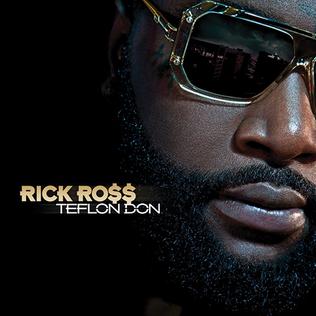
Rick Ross - Teflon Don


Rick Ross gained considerable notoriety after he was outed as the only rapper in the known history of hip-hop to have  fabricated and/or exaggerated his drug-selling, crime-kingpin past. It is a well-known fact that rappers never make songs claiming things they never did nor adopt exaggerated cartoonish personas for the sake of their music. Many a loyal fan were aghast at the incredible revelations that Ross (not even his real name) did not in fact move cocaine between Miami and South America in such massive quantities that he was friends with ousted Panamanian dictator Manuel Noreaga, and Colombian drug cartel kingpin Pablo Escobar. It was also suspected that Ross does not have million-dollar piles of cash laying round his house nor does he sleep with a different XXL Eye Candy model every night. Even the title of his latest album - Teflon Don - was controversial since no rapper till then had ever taken on a name or used an album title or spit lyrics that  paid homage to past legendary and sometimes fictitious gangsters.


Suffice to say this is the only Rick Ross I find worth listening to all the way through. It's not that the songs are any different in theme or content from his 3 previous albums - but what Ross does on this album is hit harder than he has ever before. From the first track to the last Ross rips on the high-flying  beats spinning incredible tales of crime and debauchery and death. Ross' rhyme skills have come a long way from Port of Miami and it seems he can hold his own against anybody these days.


I'm not particularly a fan of the message that rappers like Ross send kids about what's important in life, but I mean you don't send kids to watch Scarface or The Godfather in order to learn life skills (or at least you shouldn't.) This is adult entertainment for adults.


It's not very original or ambitious but the point is that Ross has finally done a complete album and pretty much answered his critics. To me this is what I like the most about him - he refused to back down in the face of criticism and attacks. There's a couple of weak tracks like M.C. Hammer and the B.M.F-style pounding beats get used too often but this is clearly one of the best rap albums of 2010 and should have gotten Grammy nod.


The really ironic thing is that Ross might be the most genuine, 'realest' rapper in the game today. The music and videos of Teflon Don are so over-the-top and dramatic that no-one could really connect any of it to what real-life is. Rick Ross delivers pure unabashed entertainment and that is what rap should be about.


Monday, June 06, 2011

It's better to be good

There's a phrase that people use in every arena of competitive human life, from pro basketball to warfare: it's better to be lucky than good. When two NBA superstars battle each other to a standstill with their supreme skills, and some 36 year-old washed up veteran on a minimum contract hits the game-winning shot from way outside his range, you hear it. When the newest, greenest kid in the squad gets shot at point-blank range and the round ricochets off his helmet and into ground leaving him without a scratch, you hear it. 'Good' meaning smart, skilled, experienced, strong. But there's another way to look at it - the other meaning of good - something that you can apply to the whole of life I think.

When I was in Standard 4 - I guess I was 8 or 9 - I had this teacher called Miss Nagir. I can't remember if she was married or not because we called all our teachers Miss, but anyway she was very forward-thinking about some things. I say this because I remember we had a spelling test where we had to spell the words PENIS and VAGINA and CLITORIS; which for many of us was the first time we were hearing those words and had no idea what they meant, which caused all kinds of hilarity for the rest of kids who knew what they were. I can't imagine the looks on some of the parents' faces when they asked their kids what they did in school that day. But anyway she had this policy where all desks had to be co-ed - one boy and one girl to a desk. Which was quite exciting for many of us because it would be the first time we would actually not be sitting with somebody who was the same sex as us. Growing up as we did in a small village, we were always shy and tentative with regard to the opposite sex. Maybe it's different in the schools in bigger places. So anyway I had to sit next to this girl named Maria and we started talking and at some point she showed me how she could whistle with her fingers and asked me if I knew who taught her how to whistle. I said no and then she said "my boyfriend." All I remember doing is picking back up the thing I was reading and thinking to myself what an odd thing that was to say to somebody you just met and what a curious thing it must be to be a girl.

I didn't get it then and I still don't. I've never been good with that stuff and I never will be. Part of the reason I like working with computers and math and stuff is that it's always a binary, black-and-white thing: you're either right or wrong. Your program either works or it doesn't, your proof is either correct or flawed, you either understand something or you don't. A model or theory or design either succeeds or it doesn't. Even with trying to write it's always you either suck at it or you don't and most people can't really conceal it one way or the other. My whole life I've always loved knowledge like that. I really never had any opportunity to practice those shadow arts of looks and signs that men and women use on one another, speak in secret alphabets as Jim Morrison put it. People who really know me know that I'm pretty blunt and forceful with regard to showing my feelings. I also never had much use for deceit or manipulation or scheming. You can't scheme your way in or out of set theory or system administration or quantum physics. So this is the model I always applied, quite disastrously, to everything in life when I was younger.

I know, now, that many if not most women wake up in the morning and before they put on their makeup they put on this lying mask and they go through the day with it on, lying to their parents and friends but most of all to themselves. They try their best to cover up how ugly and deficient they are inside with pretensions and charm, and many times they succeed. This isn't something that I knew when I was younger because I was just fortunate or unfortunate enough not to grow up with women like that. The women who raised me, for whatever reason, had very little use for artifice or deception or even nuance, either for the sake of their family or the men who loved them. If you did good they told you and if you screwed up they told you, usually several times, in quite a loud and forceful voice, and that was it. Whatever their faults and shortcomings my family was always open and honest about everything. Coincidentally or not these women didn't seem to invest much time in envy. When the people they knew were happy, they were happy for them, and when they were hurting or brought low, they tried to comfort and pull them up.

So, for better or worse this is how I was raised. I'm not being simplistic when I say that I don't understand envy because it is the truth. I guess I envy Bill Gates or Mark Zuckerberg or whoever's dating Taylor Swift...except that I really don't and I never will. I want to get my own things in life - I want to create new things. I want somebody who loves me for who I am - the real things inside me. I don't have any interest in what other people have and I never will. The three things that I have always wanted to do in life from since I knew myself were to understand, create, and love. I don't have a lot of interest in anything else. But there are a heck of a lot of men and women who seem to be only interested in destroying things, deceiving people, hatred, malice, and envy.

I also don't understand women who like to hurt their friends because of envy. For better or for worse I've always been very black-and-white with my friends. It is inconceivable to me to try to hurt in any way somebody who I thought of as my friend, especially for the sole reason that he or she had something that other people liked and I did not have. Of course people aren't black and white and part of the wisdom that you get as you get older is that there are different types of friends - different levels of trust. Women I guess if they're lucky learn this from early on, but I daresay many men do not not. I can never understand why somebody would actively work towards hurting her own friend who trusts her a lot, just because of envy. This is the one thing I find unforgivable about envious people - they have no concept of what it means to create your own destiny. They see life just as whatever you can get by whatever means. But I mean that's just how the world is. If you're lucky enough to be smart and wise you might be able to avoid trusting these people, but if you're not then you will basically end up hurting yourself and the people who really care about you.

The wisdom of this world is survival of the fittest - you have to be smart and strong to survive. But it seems to me, no matter how smart you are, you are always going to meet people who are just stupid and low-minded enough to connive and scheme and do and say anything to satisfy their small minds. No matter how strong you are, you're always going to meet people who are going to exploit your vulnerabilities and betray your trust. But I believe, just like C.S. Lewis wrote in his Narnia books, that there is a wisdom that is older than this world. I believe that the one thing you can teach your kids to equip them for dealing with this world, the most important bit of wisdom you can impart to them, the thing that my family always taught me, is that goodness always wins in the end. No matter how long it takes, no matter how far you fall, no matter how irreparable the things you do may seem, in the end life is a circle. Everyone will get what is coming to them.

I really, really used to wish I was smarter and stronger when I was younger - I might have been able to avoid a whole ton of hurt and pain both for myself and for the people I really cared about. But the thing that I've realized is that it's not really about that - those aren't the most important things. I'd like to posit that trying your best to do the right thing, to help others, to at least avoiding harming others, to be sympathetic with other people's joy, to not be envious, to believe in the right thing; to me that is more important than being really smart and really strong. Samson was the strongest man in the whole Bible - no army could defeat him - but he still got deceived by somebody he thought he could trust. But in the end God still crushed his enemies; not because he was the strongest but because God believed him to be good inside. And the truth is that I've never seen the stupid, small-minded, ugly women who wanted to hurt me and their friends for no good reason except pure malice and envy, succeed in anything they do. And I have never seen the women who were pure and beautiful and perfect inside not be blessed and happy. So as far as I see, I'm not very strong or smart especially where women are concerned, but I did always try my stupid black-and-white best to do the right thing. And that has always been the most important thing.